

Chantilly: Where Horses Are Still at Home
At the Great Stables of Chantilly, horses are preserved in art, celebrated in racing and trained through the forest. A visit reveals why this elegant French town remains one of Europe’s great living cultures of the horse.
At Chantilly, the first surprise is that the most theatrical building is not the château.
Across from it stand the Grandes Écuries—the Great Stables—with a sweeping dome, formal galleries and the serene confidence of a palace. Built between 1719 and 1735 for Louis-Henri de Bourbon, the seventh Prince of Condé, they could accommodate nearly 240 horses. The question they quietly ask is irresistible: what kind of world builds a palace for horses?
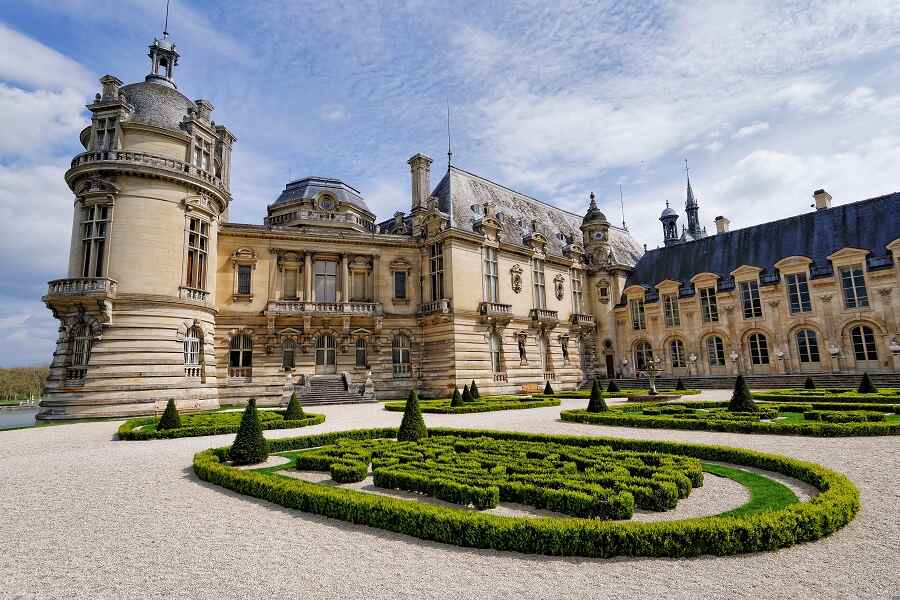
North of Paris, at the edge of its great forest, Chantilly draws visitors for the Condé Museum, the gardens, its famous cream and the race days. But the horse is the thread running through the place—its architecture, landscape, sport and daily life.
The Great Stables were designed by Jean Aubert for a princely hunting establishment, when a horse meant far more than leisure. It carried people across land, into war and through ceremony; it represented wealth and authority, but also the freedom humans have always admired in an animal more powerful than themselves. Chantilly put that relationship in stone, at monumental scale.
Today, the building houses the Living Museum of the Horse, and that word living changes everything. Paintings, harnesses and stories trace the horse as companion, traveller, worker, performer and symbol. Yet this remains a stable, with the breath, movement and particular presences of animals who give history a pulse. The museum’s equestrian company still works with horses, ponies, donkeys and a mule within the Great Stables, while demonstrations and seasonal productions bring classical horsemanship into the present.
The museum invites us to admire horses. Chantilly’s racecourse reminds us what admiration demands. Modern racing took root here in 1833, when an informal race was held on the broad lawn before the château. The first official meeting followed in 1834; then came the Prix du Jockey Club in 1836 and the Prix de Diane in 1843. The Jockey Club is a defining French Classic. The Prix de Diane may be famous for hats and garden-party charm, but its heart belongs to three-year-old fillies: a few decisive minutes at the end of months, sometimes years, of preparation.
Beauty is visible here, but never separated from work.
The château, rebuilt by Henri d’Orléans, Duke of Aumale, protects the other side of the story. By giving the estate and his collections to the Institut de France in 1886, while retaining their use during his lifetime, he ensured that the château, its art, gardens, stables and landscape would remain connected. He kept a world intact.
A short drive away, in Avilly-Saint-Léonard, I met Amanda Zetterholm at George & Zetterholm Racing, now known as NGAZ Racing: a working yard on the edge of Chantilly, with access to France Galop’s training grounds. The distance from the Great Stables is small; the emotional shift is immense. Inside the museum, the horse is remembered through art and performance. Here, it returns to its present tense.
Later, in the forest, I began to understand why Chantilly is so prized. It is beautiful in the way a place becomes beautiful when it has purpose. The tracks slip beneath old trees; wide sandy avenues carry horses in strings, their riders moving in disciplined formation.
France Galop’s Chantilly training centre extends across almost 2,000 hectares of forest and provides 120 kilometres of tracks for around 2,500 racehorses trained by roughly 110 trainers. The Piste des Lions sits among grass gallops and schooling grounds for hurdles, steeplechase and cross-country. The forest is part of the horses’ education.
Around us, horses moved at different paces, following particular programmes. A young horse learns to relax behind another; a natural runner is asked to hold something back; another is strengthened through circular gallops, which teach balance before speed. The long straights build lung and stamina. Faster work comes at the right moment, not simply because a race is approaching.
I left Chantilly thinking that its real luxury is not simply the château, the cream, or the glamour of Prix de Diane hats. It is continuity.
The Great Stables honour the horse as art and memory. The museum makes its human history visible. The racecourse turns it into ceremony. And in the forest, before visitors arrive, the work continues: horse by horse, mind by mind, morning after morning.
That is why Chantilly stays with you. It did not preserve horses as an idea. It kept them at home.

