

Amsterdam’s Canal Houses and the Architecture of Negotiation
I did not come to Amsterdam looking for an architectural lesson. I came looking for air. Europe in summer has changed its temperament. What was once imagined as a season of long evenings, linen shirts, terrace cafés and effortless beauty have become a confrontation with heat. Paris, London, Rome were still magnificent, but old stone cities have a particular way of holding the sun. Their beauty remains composed while the body begins to surrender.
So, when I arrived in Amsterdam and saw the canals, I felt something close to gratitude. Water. Movement. Reflection. The canal boat moved gently from the dock, and Amsterdam began to reveal itself differently. On land, the city has its own choreography: bicycles, trams, crossings, suitcases, tourists and locals who cycle as if punctuality were a national instinct. But from the water, everything softened. Bridges became frames. The houses leaned towards the canal like old neighbours with excellent memory. Windows appeared twice, once in brick and once again in reflection, trembling slightly in the water.
Everyone knows the postcard version of Amsterdam: tall narrow houses, decorative gables, canal reflections, and that charming crookedness that makes visitors reach instinctively for their phones. Yet from the boat, they became more than picturesque. They looked less like architecture made for admiration and more like architecture that had survived a long conversation with life.
Amsterdam’s canal houses are not architecture of perfection. They are architecture of negotiation.
They negotiate first with land, because Amsterdam was never given land easily. It had to drain, reclaim, stabilise, calculate and live with the constant presence of water. The canal ring — the grachtengordel — was not created merely to be beautiful. It was an act of planning and discipline, a system of movement, trade, residence and control. Water was infrastructure long before it became scenery.
They negotiate with space, because the houses are narrow but never small in ambition. Their facades are slim, almost restrained, but behind them life once extended deep inward: rooms, storage, offices, courtyards, rear houses, private worlds. A merchant’s canal house, or grachtenpand, was not simply a home. It was reputation, business, domestic life and social statement compressed into one vertical form.
And they negotiate with ego, which is perhaps the most human part.
The Dutch are often described as practical, but the canal houses suggest that practicality has always made room for quiet theatre. Look at the gables. Some are stepped, some curved, some severe, some more decorative. They rise above the facades like architectural signatures. One house seems to say, “I am disciplined and respectable.” The next says, “I am also respectable, but please notice my taste.” Other leans forward slightly, as if listening to what the neighbours are worth.
From the boat, the canal houses looked like characters. One resembled a retired banker. Another, a widow who still dresses properly for breakfast. One was so thin I felt it needed encouragement. A few seemed faintly drunk, although perhaps that was the reflection in the water, or perhaps Amsterdam simply has a generous relationship with interpretation.
The canal also had a way of changing social class within minutes. One moment we passed a grand hotel on the water, the kind of building that does not merely offer rooms but announces arrival. Amsterdam knows this form of luxury well: old brick, polished windows, discretion, history and the quiet confidence of a city that has hosted merchants, bankers, artists and people who prefer their breakfast with a view of civilisation.
Then, almost immediately, the mood loosened. Near Waterlooplein, the city became less polished and more human. The flea market appeared like Amsterdam’s open drawer: vintage jackets, old books, bicycle parts, small antiques, objects with uncertain origins and possibly more personality than their owners. I liked this sudden democracy of things. After all the proud gables and grand facades, here was another kind of architecture — the architecture of second chances.
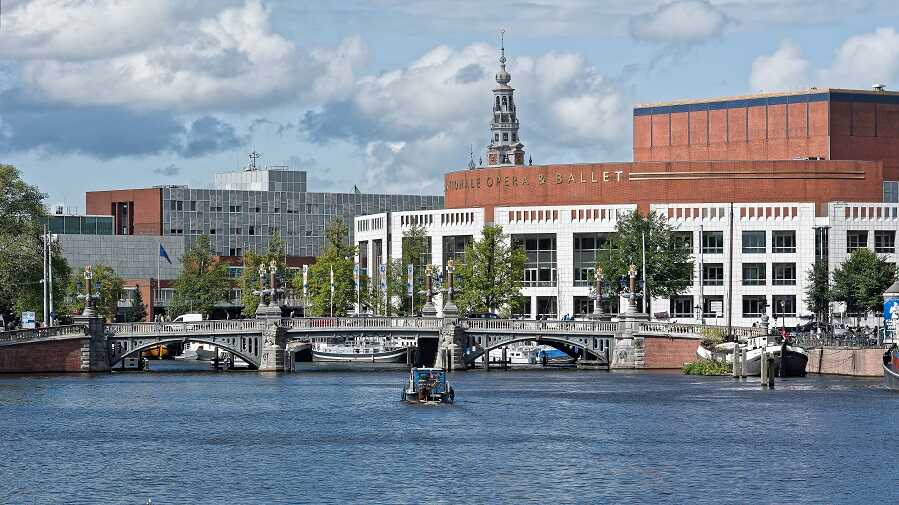
And then came the Stopera. Even the name sounds like a compromise: Stadhuis and opera forced into one civic marriage. Our guide pointed it out with the kind of amusement that suggested Amsterdam has not entirely forgiven the building. It is home to the city hall and the Dutch National Opera & Ballet, yet its construction was once fiercely contested. There were protests, anger, delays and the memorable slogan “Van Stopera naar Slopera” — from Stopera to demolition.
The city is not a museum of perfect taste. It is a living argument. A grand hotel can sit near a flea market. Opera can share a body with bureaucracy. A controversial building can stand beside the water while centuries-old canal houses lean nearby with superior manners. Amsterdam does not edit out its contradictions. It lets them float past you, one bridge at a time.
The boat guide spoke of history and details, but my mind wandered in the best possible way. I began to think about how cities reveal themselves when we stop rushing through them. On foot, I might have admired the houses, photographed a few, avoided a bicycle, found a café, complained silently about the heat and moved on. From the canal, held by the slow pace of the boat and the relief of the breeze, I had time to look properly.
And looking properly is different from sightseeing. The beauty of Amsterdam is not careless. Even its irregularity has intelligence. The narrow plots, valuable canal frontage, upper storage spaces, lifting beams, deep interiors and proud facades all belonged to a working city. What appears romantic today was often practical yesterday. The city did not become beautiful by escaping difficulty. It became beautiful by making difficulty useful.
Perhaps this is why the canal felt so meaningful during a summer of European heat waves. We often travel to escape something: weather, routine, noise, responsibility, even our own repetition. But the best journeys do not only offer escape. They offer a new way of reading the world.
Amsterdam reminded me that grace is not always born from ease. Sometimes it is born from adaptation. From knowing how to live with water without pretending to defeat it. From building narrow but deep. From allowing old houses to lean and still remain loved. From turning necessity into elegance.
That afternoon, escaping the heat on a boat in Amsterdam, I did not find a perfect city. I found something more interesting. A city that has learned how to bend without losing its grace.

