

In the Hands of Women: Memory, Dignity, and Continuity at Jakarta’s National Museum
Jakarta was moving at full speed outside. Cars pressed forward. Meetings folded into coffee. The capital carried on in its usual register of appetite and urgency, as if every street had somewhere more important to be. And then, inside the newly restored National Museum, something shifted. The city loosened. Light settled. The eye learned to stay longer.
Reopened in October 2024 after a major revitalization following the 2023 fire, the museum now feels clearer, grandeur, calmer, and more intimate in the way it tells Indonesia’s story. Long known as Museum Gajah, the Elephant Museum, it no longer feels like a place where old things wait behind glass. It feels like a place where a nation is learning how to read itself again.
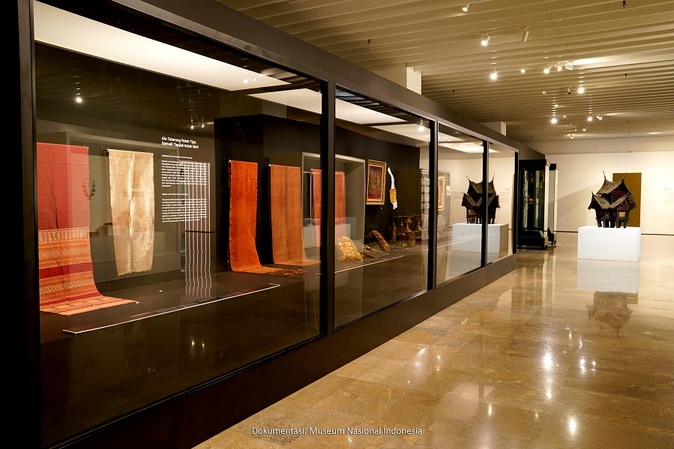
You move through the galleries and begin to sense the scale of what is being held here: stone figures, gold, ceramics, textiles, manuscripts, objects of ritual and daily life. Not simply artefacts, but traces of how people once understood beauty, order, belonging, and the sacred. The museum’s renewal is not only architectural. It gives more room for meaning to breathe.
And then, somewhere within that larger national conversation, Sumatra begins to speak. Not loudly. Not theatrically. But in a way that makes you stop walking.
For me, that moment came in the Minangkabau section from West Sumatra. There were garments, ornaments, manuscripts, and miniature architectural forms. There was the shimmer of woven cloth, the discipline of ceremonial dress, the unmistakable rise of the rumah gadang roofline. But what held me was not only beauty. It was the sudden recognition that this was the shape of a civilization in which women had long stood near the centre of continuity.
That is what makes Minangkabau so compelling. It is one of the world’s best-known matrilineal societies, where descent and inheritance pass through the female line, and where the ancestral house belongs to the women of the clan. This is not symbolic. It is structural. It shapes who belongs, who inherits, and how continuity is carried forward. UNESCO’s reading of the Traditional Settlement at Nagari Sijunjung makes this especially clear: the rumah gadang is not just an architectural emblem, but a living expression of a matrilineal order. That distinction matters, because it changes the way one sees the house.
The rumah gadang, with its dramatic upward-curving roof, is often photographed for its beauty. And yes, it is beautiful. But it is also more than that. It is a social institution. It is where lineage becomes visible, where memory is held, where inheritance takes form. UNESCO notes that these traditional houses symbolize matrilineal-based clans within the nagari, the Minangkabau settlement system. In other words, the house is not simply where life happens. It is one of the ways life is ordered.
The same is true of the word nagari itself. To call it merely a village is too small. A nagari is a whole social world: house, land, market, graveyard, mosque, customary hall, kinship, obligation, inherited value. It is one of those concepts that reveals a culture’s depth at once. This is why Minangkabau should not be read as folklore, nor as a charming regional tradition preserved for display. It is evidence of a highly organized living civilization, one in which architecture, social order, and family structure are deeply intertwined.
The museum understands this beautifully. It does not present Minangkabau as costume. It presents it as coherence.
The garments on display help tell that story with quiet authority. Minangkabau ceremonial dress is not simply festive clothing. It belongs to adat, to customary life, and carries social meaning. The richness of songket, the balance of jewellery, the headpieces, the way the silhouette holds dignity rather than display – all of it suggests a culture in which beauty has discipline. Ornament is not an extra. It is language.
The exhibition drew on 81 objects from the collection of Sativa Sutan Aswar, known as Atitje – a sociologist and cultural advocate remembered for her work preserving Indonesian textiles and supporting the artisans who keep those traditions alive. Her name matters because it reminds us that heritage does not survive through admiration alone. It survives because someone, somewhere, cared enough to protect it before the world remembered to value it.
Then there are the manuscripts. And manuscripts change the feeling of a gallery. They tell you at once that this was not only a people of form, but a people of thought. Minangkabau manuscript traditions point to texts on law, ethics, healing knowledge, religious learning, customary regulations, stories of prophets, and the discipline of learning itself, often preserved through the culture of the surau. Suddenly, the textiles and houses begin to sit within a fuller world. The elegance of the visible was never separate from the life of the mind.
And yet perhaps what makes Minangkabau most interesting is that it is not simplistic. Because a society can be matrilineal and still carry patriarchal shadows.
Women may hold descent, inheritance, and the continuity of the house, while visible authority in wider public and customary life may still move through men. That tension is not a flaw in the story. It is what makes the story real. Women remain central to lineage and property, yet patterns of male-dominated public decision-making can still persist. Respect does not always dissolve hierarchy. Centrality does not always mean public dominance.
But perhaps that is why the story lingers. Because it offers something more mature than a slogan about empowerment. It suggests that women’s power may also live in continuity, stewardship, rootedness, and the right to carry memory forward. Not always loudly. Not always visibly. But enduringly. And in a country with the world’s largest Muslim population, that living tradition carries its own quiet force: a reminder that women’s centrality in society can have deep local roots, expressed not through manifesto, but through custom, inheritance, and the architecture of everyday life.
When I stepped back outside, Jakarta was still Jakarta – fast, intent, already turning toward whatever came next. But I had been given another measure of civilization. Not monument. Not conquest. Not volume.
The intelligence of a house.
The structure of a settlement.
The shimmer of cloth carrying rank and memory.
The quiet fact that women had long stood near the centre of it all.
In the middle of Jakarta’s relentless forward motion, the National Museum holds a culture that still knows how to place memory, dignity, and continuity in the hands of women and let that knowledge endure.

Wonderful Indonesia Showcases “Go Beyond Ordinary” Tourism Promotion at Sitf 2026 in Seoul
