

When Tokyo Speaks in Whispers
Tokyo does not reveal itself in a single glance; it is not a city that rushes to introduce its personality, nor does it perform for the traveller who arrives expecting immediacy or spectacle. Instead, Tokyo waits patiently, almost politely – allowing you to step into its atmosphere and adjust your senses to a frequency where things are not merely seen but quietly absorbed, where meaning is encountered not through noise but through an accumulation of small, precise gestures that speak more deeply of a place than any landmark could.
Learning to Move with the City
There is an art to entering Tokyo, one that most travellers miss because they assume the city demands speed, when in truth it demands awareness. On the Metro, where the crowd moves quickly yet never frantically, where bodies enter and exit carriages with the synchrony of breath, where nobody speaks loudly or answers phone calls or attempts the self-important choreography of selfies, you begin to notice that Japan’s famed efficiency is not built on rules but on a shared belief that one’s behaviour should never impose upon another.
I watched the way commuters angled their shoulders to create space without making a performance of politeness, the way a mother steadied her child with a single, almost ceremonial gesture, the way a businessman held his briefcase to his chest, shielding, not occupying and I understood that omoiyari, the Japanese instinct for consideration, is not taught through lectures but absorbed through daily observation.
Where Something Quiet Inside You Settles
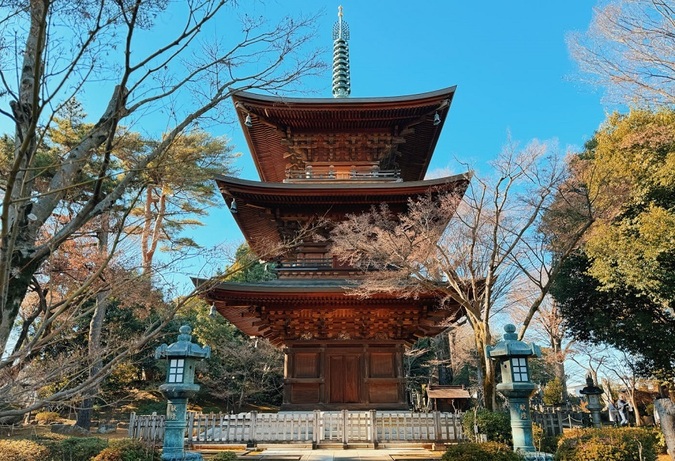
Gotokuji Temple, often reduced to a picturesque cluster of beckoning cats on social media feeds, revealed itself as something far more profound once we stepped past the gate and into its measured stillness. The gravel, meticulously raked, made sound only when you allowed it to. The air, scented faintly with cedar and incense, carried an unspoken invitation to lower the volume of your inner world.
A monk swept the courtyard with slow, resolute strokes, performing a kind of devotional maintenance that blurred the distinction between spiritual practice and daily habit. The humility of his movements reminded me that in Japanese culture, repetition is not monotony; it is refinement. You deepen yourself by doing the same thing with greater awareness each time.
Standing among the rows of maneki-neko – white cats with raised paws, symbols of invitation and protection, I felt the subtle arrival of memory. Not the sharp, grief-edged memory that startles the heart, but the softer, atmospheric kind that enters like weather rather than thought. My mother’s presence was not a longing; it was a quiet alignment, a recognition that the Japanese belief in ancestors accompanying meaningful journeys was less superstition and more an intuitive understanding of how love continues.
Landscape as Philosophy
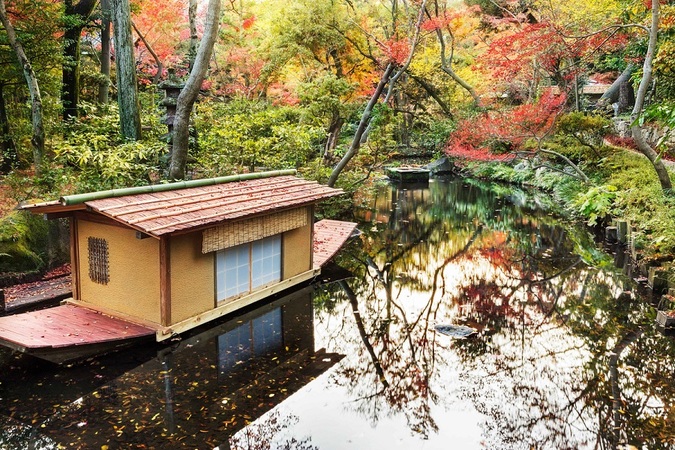
Nezu Museum’s garden is less a place than a meditation rendered in moss, stone, and light. Under the bamboo canopy, where the sun filters into thin, vertical ribbons, you begin to sense the intellectual spine behind Japanese aesthetics:
shibui, the allure of restraint;
ma, the eloquence of empty space;
wabi-sabi, the dignity of impermanence;
mono no aware, the tender awareness that all beauty is shaped by its transience.
The garden does not guide you; it suggests. Paths curve gently, leading you not to destinations but to states of thought. A single red maple leaf resting on a stone becomes a lesson in composition. The silence becomes participatory.
I walked in loose formation, sometimes falling into step, sometimes drifting apart without explanation. And in that drifting, I understood something essential: a garden like Nezu is built not to impress but to recalibrate you – to return you to yourself with a quieter mind and a more discerning gaze.
It was here, in the interplay of shadow and water, that I felt the emotional subtlety of travel: the way a place can touch the interior of your life not through drama but through precision. The way grief, when held in an environment that honours silence, loses its jaggedness and becomes something almost companionable.
The Discipline of Elegance

Kimono is not merely attire; it is a structure – one that shapes your posture, your breath, your pace. As the fabric wrapped around my body and the obi tightened into a firm yet gentle anchor, I found myself moving with an attentiveness that felt foreign at first, then surprisingly natural. Fashion, in many cultures, is an expression of individuality; in Japan, traditional clothing is an expression of harmony.
When an elderly woman paused, bowed lightly, and offered a soft “kirei desu ne,” it felt less like flattery and more like acknowledgment that we had entered her culture with sincerity rather than performance. This, we learned, is omotenashi at its purest: hospitality as a quiet, mutual respect that flows without expectation.
Where the City Lowers Its Voice

At Suga Shrine, the staircase leading up to the wooden torii felt like a slow exhale. Evening light softened the edges of the city, turning rooftops into silhouettes and the air into something almost ceremonial. A young girl performed the sequence of saikeirei with the reverence of someone who has inherited not just a ritual but a worldview, one that understands respect as movement rather than proclamation.
Her gestures were small, precise, sincere, and something about the way her hands came together, clean, deliberate – felt like the distilled essence of Tokyo’s ethos: that depth is not in magnitude but in intention.
What I Carried Away
What I carried away from Tokyo was not a memory but an inspiration – a quieter way of noticing, a gentler posture toward the world. Between the temple and the garden, the rush of the Metro and the stillness of the shrine, I understood that Tokyo had not merely revealed a city; it had offered a way of being, one that values subtlety over certainty, attention over assumption, and silence as a form of intelligence. It is a way of living that feels, in many ways, like truth finally spoken quietly.

